Rope access is still how the hard work gets done on an offshore production platform. But nowadays, with plenty of technology at our disposal, drones decide where that work is worth doing.
Trussco, Inc. – a Muehlhan Industrial Service’s company – started flying Unmanned Aerial Vehicles (UAVs) alongside our rope access crew for a simple reason: Too much of a campaign was spent hanging people on members that only needed a look, and sending entry teams into center wells and columns before anyone knew the atmosphere.
That was a bed space issue, a weather-window conundrum, and a safety concern. It was not a skill problem though.
This is how we took the best advantage of technology
So, let us explain how these two methods – flying UAVs and Rope Access – work together on an offshore production platform. The drone does the General Visual Inspection (GVI). It flies over the shell and frame, goes over the underdeck, the flare boom, the pedestal cranes, flies over all the conductors, the splash zone, and the well bay. Worth saying that it does all that by capturing it in high-resolution video.
Drones can also do GVI into the enclosed spaces that used to take a whole morning of permits, such as center wells and columns. Another asset is the possibility to make multi gas monitor rides on the drone confirming if there are safe atmospheric conditions (checking O2, LEL, H2S, CO levels). Besides live readings on the screen, it’s possible to see if there’s standing water, debris, and internal damage. That is the difference between inspecting a space and entering one.
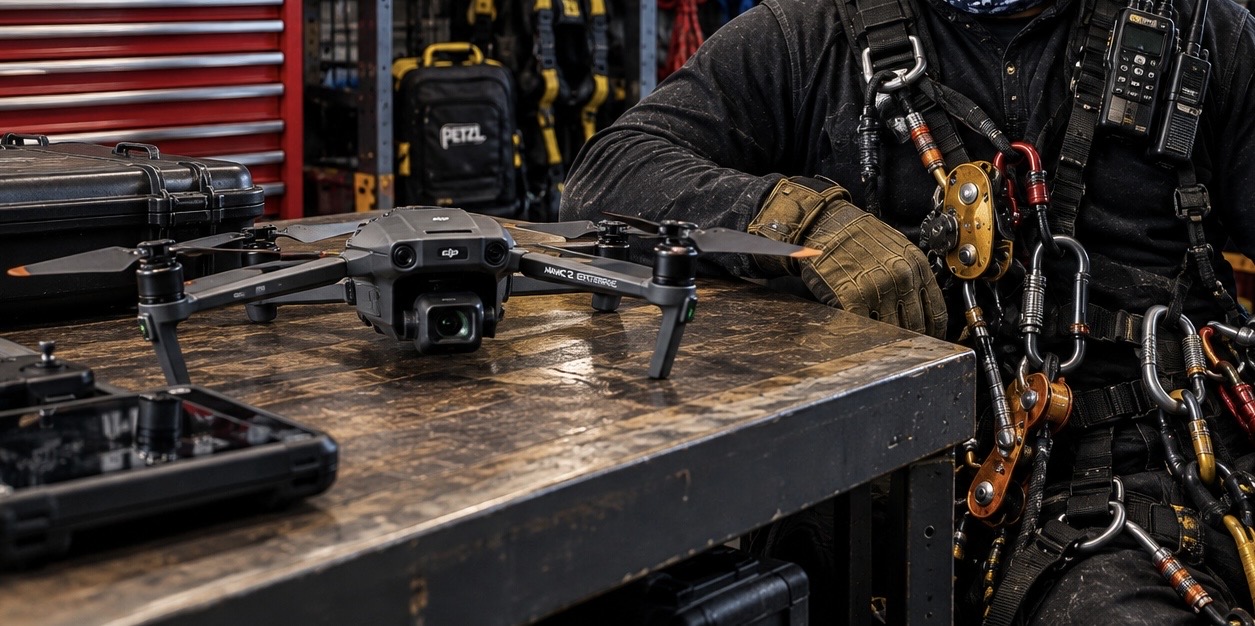
Useful usage of man and machine
Rope access does what a camera cannot. For example, cleaning, repair, the drop that needs a hand on the steel, visual inspections at arm’s length on the defects the drone flagged, and hands on inspections, such as Ultrasonic Testing, Magnetic Particle Inspection, and Dye Penetrant Inspection.
During an Ultrasonic Testing, the person needs to send high-frequency sound waves through a material to detect and size hidden internal flaws, such as lack of fusion or inclusions for example, and measure thickness. For a Magnetic Particle Inspection, a professional is required to magnetize ferromagnetic components and apply iron particles to reveal surface-breaking and slightly subsurface cracks. And for Dye Penetrant Inspection, for instance, a capillary-action liquid dye is applied to a clean surface to detect surface-breaking defects in non-porous materials (magnetic or non-magnetic).
UAVs cannot do that.
Rescue capability stays on the permit. We did – and will – not replace the Level 3, we have given him another tool to make the project safer, faster and more efficient.
Continuous training
For us to master that, we need to train our rope access technicians as drone pilots. The same rope access team writes the rescue plan and flies the center well. No second vendor to take up more bed space. If wind grounds the drone, the rope team will rig and drop into the void. If the overside job dies, they fly the well bay. Headcounts stay as low as the work allows.
One crew. One work pack. One report.
That is the product. Not a drone day rate sitting next to a rope day rate for the client to stitch together. It’s working alongside technology to get the best of two worlds.
Tyler Jones
Operational Manager, Trussco, Inc., a Muehlhan Industrial Service’s company